Beyond the Pitch: The World Cup's Impact on Connecticut Aviation
By John Gabriel

Private Jet Travel for FIFA World Cup 2026
When the World Comes to Our Doorstep: How FIFA World Cup 2026 Is Reshaping Business Aviation in Connecticut and the Northeast
Every few years, a global event lands close enough to home that our industry feels it directly. The 2026 FIFA World Cup is one of those events — and for Connecticut's business aviation community, its impact is already being felt from the flight deck to the FBO counter. What makes this summer uniquely challenging is that the World Cup hasn't arrived in a vacuum. It has landed squarely on top of one of the busiest seasonal aviation cycles in the Northeast, and the operational pressure points are compounding fast.
The TFR Picture
Pilots and dispatchers in our community need to be fully fluent in the airspace restrictions now in force. On match days, standard game-day TFRs encompassing a roughly 3 nautical mile radius around the stadium from the surface to 3,000 feet should be anticipated, beginning approximately three hours before each game and ending about three hours after the game concludes.
Following the conclusion of each match, departure delays are likely as traffic filters out of the area that evening and the next morning, and route structures may be published ahead of matches to streamline traffic flows and balance volume through ATC sectors. Members should monitor the FAA's Current Reroutes page regularly throughout match weeks.
Beyond the stadium TFRs, the FAA has designated all FIFA World Cup 2026 stadiums and surrounding event spaces as strict "No Drone Zones," with additional restrictions applying to team hotels, base camps, and training facilities. TFR information is published by FDC NOTAMs, normally 3 to 5 days prior to the event. For any member with UAS operations, the consequences of a violation are severe. Pilots who violate these TFRs face fines of up to $100,000, permanent confiscation of equipment, and potential federal criminal charges.
Airport Congestion and Special Event Fees: The Teterboro Ripple Effect
Teterboro (KTEB) is just a few minutes from MetLife Stadium, making it the default first choice for most operators flying their clients to matches. The consequence is predictable: KTEB will be at or near capacity on every match day through July 19. Due to this time of very high demand, the FAA has Traffic Management Initiatives that include published airport and routing NOTAMs to help maintain a steady, organized flow of traffic. One of the largest impacts is Prior Permission Required (PPR) operations at FBOs. Ramp space at FBOs as well as transient slot availability will be at a premium, both in availability and pricing. Many are now familiar with Special Event Fees (SEF) that surround high demand events such as these, and the high prices that are charged as a result. Whether it is the lack of PPR availability or the high cost of SEFs, other airports such as Westchester (KHPN) and Morristown (KMMU) will absorb some of the overflow — and the ripple effect during the final matches will extend further up the corridor than most operators are anticipating.
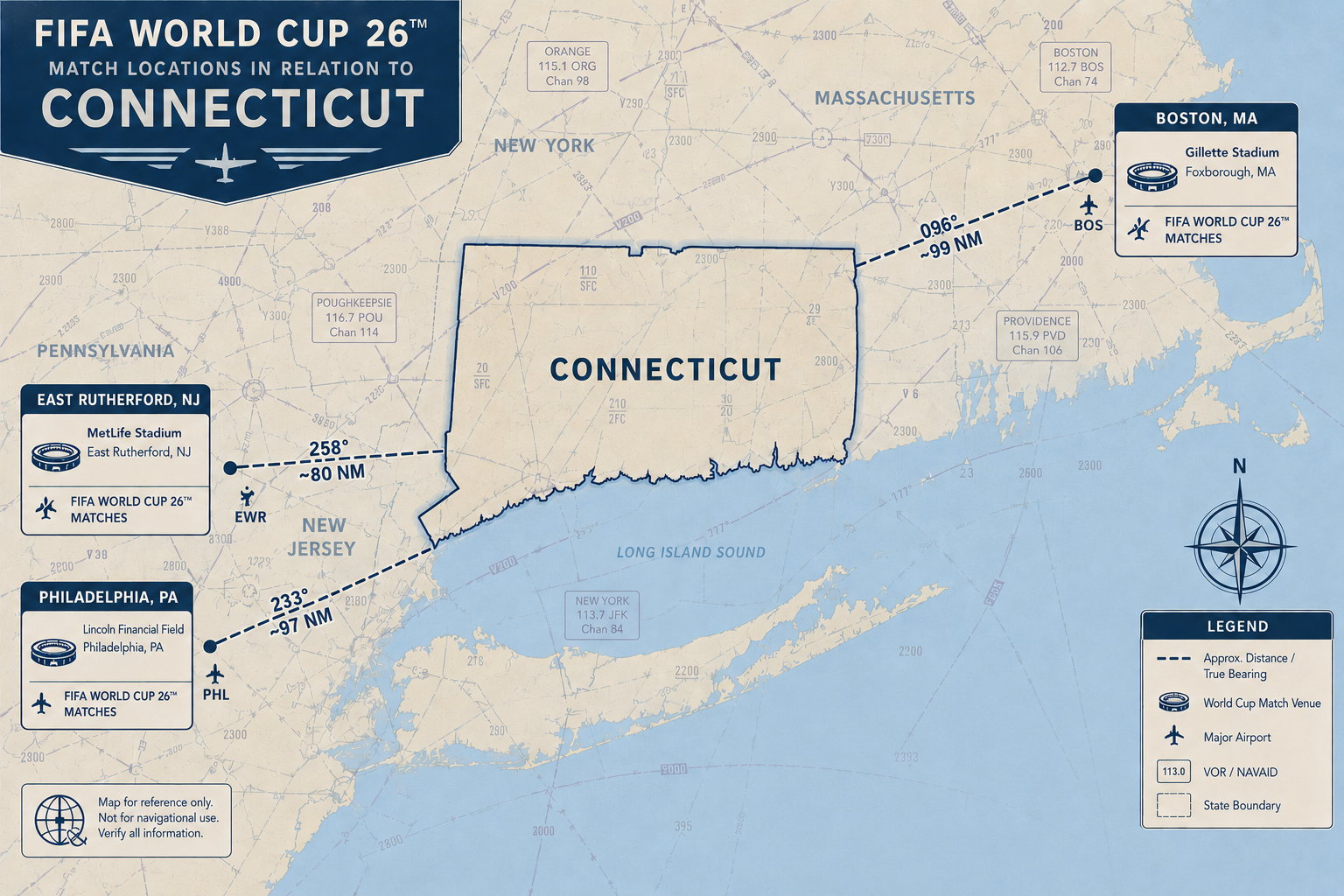
That ripple reaches Connecticut. Oxford (OXC), Danbury (DXR), and Bridgeport (BDR) are all realistically positioned to capture overflow positioning and divert traffic as the metro New York GA airports fill. None of these airports are a natural first call for World Cup traffic, but for operators who can't secure slots at TEB or HPN, a well-handled arrival at a southwest Connecticut airport with strong ground transportation to MetLife becomes a viable and attractive option. FBOs at these airports should be actively communicating capacity, availability, and ground logistics to the regional charter community now, not in July.
The Collision Nobody Planned For: FIFA Meets the Island Shuttle Season
Here is where the operational story gets genuinely complex for Connecticut operators. The World Cup's peak traffic weeks — late June through the July 19 Final — fall in direct overlap with the height of the Northeast's summer Island shuttle season. Tradewind Aviation's shared charter service between the Connecticut-area corridor and Nantucket and Martha's Vineyard, along with similar operations by Reliant Air and other regional providers, runs at its highest frequency and passenger load precisely during this window.
These shuttle operations depend on predictable block times, tight aircraft turns, and consistent routing through airspace that is now anything but predictable. On a match day at MetLife, the New York TRACON is handling significantly elevated inbound and outbound traffic, flow control programs can lengthen departure release times, and even aircraft well north of the TFR footprint — routing through the corridor to the Cape and Islands — can experience sequencing delays. A Tradewind departure from Oxford or Westchester targeting Nantucket on a Saturday evening when MetLife has just kicked off a Round of 16 match is threading a needle that didn't exist last summer.
The operational math is straightforward: when you compress FIFA-driven bizjet traffic, summer Island demand, and the region's existing commercial and GA baseline into the same airspace window, something gives. What gives is schedule integrity. Shuttle operators need to be building buffer into block times on match-day afternoons and evenings, pre-briefing passengers on potential delay exposure, and coordinating closely with ATC on preferred routing to minimize exposure to flow programs. Crews operating high-frequency turns should be especially attentive to duty time exposure if a delay cascade begins.
Demand Surge: The Numbers Behind the Pressure
The scale of aviation activity surrounding this tournament is historically significant. Industry projections estimate over 73,000 match-day related bizjet flights during the tournament, with the Cup expected to attract as many as 10 million supporters to the United States alone. Operators are already reporting strong demand for flights tied to the knockout rounds and the July 19 Final.
For Connecticut-based charter operators and flight departments, this creates real scheduling tension. The clients who want to attend the Final on July 19 at MetLife and the clients who want to be on Nantucket that same weekend are, in many cases, the same population. Managing those competing demands — aircraft positioning, crew availability, FBO slot coordination — requires more planning depth than a typical summer week.
The Business Opportunity Is Real — If You Move Now
While the operational challenges are genuine, so is the upside — and Connecticut's aviation ecosystem is well positioned to capture it, provided members are proactive rather than reactive. For Connecticut-based business aviation companies and professionals, the saturation of Teterboro and the New York metro GA airports is a direct opportunity as our state is well positioned to support any business aviation need that may arise. The opportunities exend to local FBOs at Oxford, Danbury, and Bridgeport, ground transportation and car service and in-flight catering providers, where the opportunity is similarly strong.
The common thread across all of these opportunities is urgency. The knockout rounds are already here. Members who aren't actively marketing their services, reaching out to regional charter operators, and positioning themselves as World Cup solutions rather than World Cup bystanders are leaving real revenue on the table.
A Moment for the CBAG Community
Events like this are a reminder of why regional industry organizations exist. The challenges created by the World Cup don't fall uniformly across our membership — flight departments, charter operators, FBO managers, and MRO providers are each navigating this moment differently. Sharing intelligence, coordinating referrals, and supporting one another through the operational pressure is exactly what CBAG is built for.
As the tournament moves into its knockout rounds, we encourage members to stay current with NBAA's FIFA World Cup 2026 resource page, monitor FDC NOTAMs diligently, and bring their questions and real-world observations to the conversation — including at the CBAG Summer Social at the Greenwich Polo Club on June 28th, where there will be no shortage of operational war stories to share.
The world is watching New York-New Jersey. Our community is at the center of it — and navigating it together.